
'%3e%3cellipse%20cx='122.857'%20cy='358.884'%20rx='122.857'%20ry='358.884'%20transform='matrix(0.213985%20-0.976837%200.999853%200.0171202%20106%20414.739)'%20fill='%23C07EF4'%20fill-opacity='0.65'/%3e%3c/g%3e%3cg%20opacity='0.6'%20filter='url(%23filter1_f_179_19713)'%3e%3cellipse%20cx='102.943'%20cy='194.258'%20rx='102.943'%20ry='194.258'%20transform='matrix(0.999918%20-0.0128009%20-0.182066%200.983286%20344.224%2090.6355)'%20fill='url(%23paint0_linear_179_19713)'/%3e%3c/g%3e%3cg%20opacity='0.6'%20filter='url(%23filter2_f_179_19713)'%3e%3cellipse%20cx='58.3778'%20cy='110.161'%20rx='58.3778'%20ry='110.161'%20transform='matrix(0.999918%20-0.0128009%20-0.182066%200.983286%20373.476%20172.757)'%20fill='url(%23paint1_linear_179_19713)'%20fill-opacity='0.6'/%3e%3c/g%3e%3cdefs%3e%3cfilter%20id='filter0_f_179_19713'%20x='0.299316'%20y='49.6877'%20width='981.644'%20height='502.367'%20filterUnits='userSpaceOnUse'%20color-interpolation-filters='sRGB'%3e%3cfeFlood%20flood-opacity='0'%20result='BackgroundImageFix'/%3e%3cfeBlend%20mode='normal'%20in='SourceGraphic'%20in2='BackgroundImageFix'%20result='shape'/%3e%3cfeGaussianBlur%20stdDeviation='65.5061'%20result='effect1_foregroundBlur_179_19713'/%3e%3c/filter%3e%3cfilter%20id='filter1_f_179_19713'%20x='214.438'%20y='0.83107'%20width='394.707'%20height='558.997'%20filterUnits='userSpaceOnUse'%20color-interpolation-filters='sRGB'%3e%3cfeFlood%20flood-opacity='0'%20result='BackgroundImageFix'/%3e%3cfeBlend%20mode='normal'%20in='SourceGraphic'%20in2='BackgroundImageFix'%20result='shape'/%3e%3cfeGaussianBlur%20stdDeviation='44.241'%20result='effect1_foregroundBlur_179_19713'/%3e%3c/filter%3e%3cfilter%20id='filter2_f_179_19713'%20x='301.482'%20y='123.437'%20width='220.619'%20height='313.787'%20filterUnits='userSpaceOnUse'%20color-interpolation-filters='sRGB'%3e%3cfeFlood%20flood-opacity='0'%20result='BackgroundImageFix'/%3e%3cfeBlend%20mode='normal'%20in='SourceGraphic'%20in2='BackgroundImageFix'%20result='shape'/%3e%3cfeGaussianBlur%20stdDeviation='24.2852'%20result='effect1_foregroundBlur_179_19713'/%3e%3c/filter%3e%3clinearGradient%20id='paint0_linear_179_19713'%20x1='102.943'%20y1='0'%20x2='138.749'%20y2='364.251'%20gradientUnits='userSpaceOnUse'%3e%3cstop%20stop-color='%23DF4E94'/%3e%3cstop%20offset='1'%20stop-color='%23FF74B7'/%3e%3c/linearGradient%3e%3clinearGradient%20id='paint1_linear_179_19713'%20x1='79.5736'%20y1='-21.7109'%20x2='87.7798'%20y2='224.984'%20gradientUnits='userSpaceOnUse'%3e%3cstop%20stop-color='%23E76A9E'%20stop-opacity='0.8'/%3e%3cstop%20offset='0.387309'%20stop-color='%23F2AD27'%20stop-opacity='0.8'/%3e%3cstop%20offset='0.843356'%20stop-color='%23FF8D4E'%20stop-opacity='0.82'/%3e%3cstop%20offset='1'%20stop-color='%23ED258A'%20stop-opacity='0.37'/%3e%3c/linearGradient%3e%3c/defs%3e%3c/svg%3e)
'%3e%3cellipse%20cx='605.327'%20cy='687.991'%20rx='214.134'%20ry='588.997'%20transform='rotate(37.9938%20605.327%20687.991)'%20fill='url(%23paint0_linear_179_19720)'/%3e%3c/g%3e%3cg%20opacity='0.5'%20filter='url(%23filter1_f_179_19720)'%3e%3cellipse%20cx='746.016'%20cy='777.643'%20rx='72.6077'%20ry='352.172'%20transform='rotate(-15%20746.016%20777.643)'%20fill='%23FFE1E1'/%3e%3c/g%3e%3cdefs%3e%3cfilter%20id='filter0_f_179_19720'%20x='0.930389'%20y='0.959198'%20width='1208.79'%20height='1374.06'%20filterUnits='userSpaceOnUse'%20color-interpolation-filters='sRGB'%3e%3cfeFlood%20flood-opacity='0'%20result='BackgroundImageFix'/%3e%3cfeBlend%20mode='normal'%20in='SourceGraphic'%20in2='BackgroundImageFix'%20result='shape'/%3e%3cfeGaussianBlur%20stdDeviation='102.19'%20result='effect1_foregroundBlur_179_19720'/%3e%3c/filter%3e%3cfilter%20id='filter1_f_179_19720'%20x='538.382'%20y='344.322'%20width='415.267'%20height='866.64'%20filterUnits='userSpaceOnUse'%20color-interpolation-filters='sRGB'%3e%3cfeFlood%20flood-opacity='0'%20result='BackgroundImageFix'/%3e%3cfeBlend%20mode='normal'%20in='SourceGraphic'%20in2='BackgroundImageFix'%20result='shape'/%3e%3cfeGaussianBlur%20stdDeviation='46.31'%20result='effect1_foregroundBlur_179_19720'/%3e%3c/filter%3e%3clinearGradient%20id='paint0_linear_179_19720'%20x1='819.46'%20y1='98.9937'%20x2='391.193'%20y2='98.9937'%20gradientUnits='userSpaceOnUse'%3e%3cstop%20stop-color='%2300E0EE'/%3e%3cstop%20offset='1'%20stop-color='%23AD00FE'/%3e%3c/linearGradient%3e%3c/defs%3e%3c/svg%3e)
'%3e%3cellipse%20cx='576.369'%20cy='647.951'%20rx='214.134'%20ry='536.944'%20transform='rotate(37.9938%20576.369%20647.951)'%20fill='url(%23paint0_linear_55_3438)'/%3e%3c/g%3e%3cg%20opacity='0.5'%20filter='url(%23filter1_f_55_3438)'%3e%3cellipse%20cx='685.016'%20cy='778.624'%20rx='72.6077'%20ry='352.172'%20transform='rotate(-15%20685.016%20778.624)'%20fill='%23EED4D4'/%3e%3c/g%3e%3cdefs%3e%3cfilter%20id='filter0_f_55_3438'%20x='0.793915'%20y='0.24411'%20width='1151.15'%20height='1295.41'%20filterUnits='userSpaceOnUse'%20color-interpolation-filters='sRGB'%3e%3cfeFlood%20flood-opacity='0'%20result='BackgroundImageFix'/%3e%3cfeBlend%20mode='normal'%20in='SourceGraphic'%20in2='BackgroundImageFix'%20result='shape'/%3e%3cfeGaussianBlur%20stdDeviation='102.19'%20result='effect1_foregroundBlur_55_3438'/%3e%3c/filter%3e%3cfilter%20id='filter1_f_55_3438'%20x='477.382'%20y='345.304'%20width='415.268'%20height='866.64'%20filterUnits='userSpaceOnUse'%20color-interpolation-filters='sRGB'%3e%3cfeFlood%20flood-opacity='0'%20result='BackgroundImageFix'/%3e%3cfeBlend%20mode='normal'%20in='SourceGraphic'%20in2='BackgroundImageFix'%20result='shape'/%3e%3cfeGaussianBlur%20stdDeviation='46.31'%20result='effect1_foregroundBlur_55_3438'/%3e%3c/filter%3e%3clinearGradient%20id='paint0_linear_55_3438'%20x1='790.503'%20y1='111.006'%20x2='362.235'%20y2='111.006'%20gradientUnits='userSpaceOnUse'%3e%3cstop%20stop-color='%23AD00FE'/%3e%3cstop%20offset='1'%20stop-color='%2300E0EE'/%3e%3c/linearGradient%3e%3c/defs%3e%3c/svg%3e)
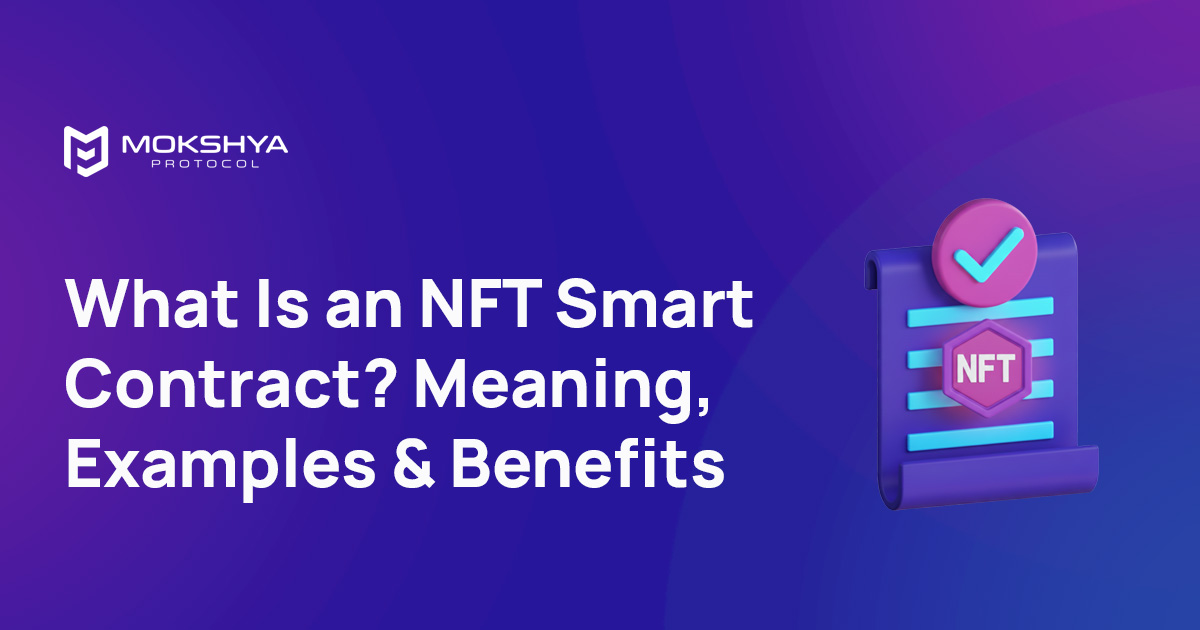
NFTs may appear as simple digital collectibles, but their real power comes from the technology working behind the scenes, NFT smart contracts. These are self-executing programs stored on the blockchain that define the rules of creation, ownership, transfer, and verification of NFTs. They ensure that every token is unique, traceable, and cannot be duplicated or altered, making digital ownership truly secure and transparent.
Without NFT smart contracts, there would be no reliable way to prove authenticity or manage ownership in the digital world. They act as the foundation of the entire NFT ecosystem, enabling creators to mint assets and users to buy, sell, or trade them with trust. In this guide, we’ll explore how these smart contracts work and why they are essential for powering modern Web3 applications.
What Is an NFT Smart Contract?
An NFT smart contract is a self-executing program deployed on a blockchain that defines how a non-fungible token (NFT) is created, owned, transferred, and managed. It contains the rules and logic that ensure each NFT is unique, verifiable, and securely recorded without needing intermediaries. In simple terms, it acts as the backbone of NFTs on an NFT blockchain, automatically handling ownership rights and transactions while ensuring transparency, security, and trust across the network.
Think of it as a vending machine. You insert money, select an item, and the machine delivers it automatically. No human controls the process once the rules are set. In the same way, an NFT smart contract executes actions like minting, transferring ownership, or paying royalties when predefined conditions are met.
These contracts are created through smart contract development, usually using programming languages like Solidity for Ethereum-based blockchains or Rust and Move for other ecosystems. Once deployed, the code becomes immutable, meaning no one can secretly change the rules later.
In simple terms, an NFT smart contract ensures that:
- Each NFT is unique
- Ownership is verifiable
- Transactions happen transparently
- Rules are enforced automatically
Examples of NFT Smart Contracts
Examples of NFT smart contracts include marketplace contracts that handle NFT minting, buying, selling, and royalty payments, such as those used by OpenSea. They are also used in games and digital art platforms to manage ownership, transfers, and creator royalties automatically. To ensure security and reliability, many projects have their contracts reviewed by a smart contract auditor.
NFT Marketplace Smart Contracts
NFT marketplaces use NFT smart contracts to manage listing, buying, and selling of NFTs. When a user purchases an NFT, the smart contract automatically transfers ownership from the seller to the buyer and releases payment. It also ensures creator royalties are paid instantly. This removes the need for intermediaries and creates a transparent, trust-based trading system.
NFT Art and Collectibles Smart Contracts
Digital artists and creators rely on NFT smart contracts to mint unique artworks and collectibles. These contracts link each NFT to its metadata, such as images and attributes, and store ownership details on the blockchain. Royalty rules are embedded directly into the contract, ensuring creators earn a percentage every time the NFT is resold.
Gaming NFT Smart Contracts
In blockchain games, NFT smart contracts represent in-game assets like characters, skins, weapons, or land. The smart contract confirms that the player truly owns the asset and can trade or transfer it freely. This ownership exists outside the game, giving players full control over their digital items.
Music and Media NFT Smart Contracts
Music and media platforms use NFT smart contracts to tokenize songs, albums, and videos. These contracts automate revenue distribution among artists, producers, and collaborators. Each time an NFT is sold or resold, payments are split accurately based on predefined rules, ensuring fair compensation without manual tracking.
Utility and Membership NFT Smart Contracts
Utility NFTs use NFT smart contracts to grant access to services, communities, or exclusive content. The contract verifies ownership before allowing entry, similar to a digital access key. This approach is widely used for memberships, event tickets, and gated platforms in Web3.
How to Create an NFT Smart Contract?
Creating an NFT smart contract requires careful planning, clean code, and proper testing. Each step builds on the previous one to ensure the contract works securely and efficiently on the blockchain.
- Choose the Right Blockchain Network
The first step in how to create an NFT smart contract is selecting a blockchain. Ethereum is widely used, but networks like Polygon, Solana, Aptos, and BNB Chain are also popular due to lower transaction fees and faster processing.
Your choice should depend on scalability needs, developer tools, and marketplace compatibility.
- Select an NFT Standard
NFT standards define how tokens behave on the blockchain. For Ethereum-based projects, ERC-721 is used for unique NFTs, while ERC-1155 supports multiple token types within a single contract.
Using a recognized standard ensures your NFT smart contract works smoothly with wallets, marketplaces, and other Web3 applications.
- Design the Smart Contract Logic
At this stage, you define how the NFT will function. This includes minting rules, ownership transfers, metadata handling, and royalty distribution.
Think of this step as writing the rules of a digital agreement. Once deployed, these rules cannot be easily changed, so clarity and accuracy are critical.
- Write the Smart Contract Code
The contract is written using blockchain programming languages such as Solidity for Ethereum-based networks. Developers often use trusted libraries to reduce errors and improve security.
Clean and well-structured code ensures your NFT smart contract performs as expected and remains easy to audit.
- Test the Smart Contract Thoroughly
Before deployment, the contract must be tested on a test network. Testing helps identify bugs, security risks, and logic issues without risking real assets.
This step is essential because errors in smart contracts can lead to permanent loss of NFTs or funds.
- Deploy the NFT Smart Contract
Once testing is complete, the contract is deployed to the main blockchain network. Deployment makes the NFT smart contract live and accessible to users.
After deployment, users can interact with the contract to mint, transfer, or trade NFTs.
- Audit and Maintain Security
Security audits help detect vulnerabilities that testing may miss. Audits improve trust and protect users from exploits.
Regular monitoring ensures the contract continues to operate safely within the evolving blockchain environment.
How Do NFTs Affect The Economy Of Creators?
NFTs are changing the creator economy by giving artists, developers, and content creators direct control over how they monetize their work. Through an NFT blockchain, creators can sell their digital assets without relying on intermediaries, allowing them to keep a larger share of their earnings. They can also reach a global audience instantly and build stronger connections with their communities.
Another major impact is the ability to earn ongoing royalties. NFT smart contracts enable creators to receive a percentage every time their work is resold on the NFT blockchain, creating a continuous income stream. This shifts the traditional model from one-time payments to long-term revenue, offering more financial stability and new opportunities for growth.
The Role of Smart Contracts in NFT
Smart contracts play multiple roles in the NFT ecosystem. They are not just technical tools; they define how NFTs function and interact with users and platforms.
- Minting of NFTs
Minting is the process of creating a new NFT on the blockchain. Smart contracts manage this by assigning a unique token ID and linking it to specific metadata. The NFT smart contract ensures that each NFT is original and records its creation permanently, which prevents duplication and confirms authenticity.
- Creation and Management of NFT Ownership
Smart contracts define and manage NFT ownership on the blockchain. When an NFT is bought, sold, or transferred, the contract updates ownership automatically. This creates a transparent and verifiable ownership history, showing clearly how NFT ownership on blockchain works without intermediaries.
- Interoperability
Interoperability allows NFTs to function across different platforms and applications. Smart contracts follow standard rules that wallets, marketplaces, and games recognize. This enables the same NFT to move and operate smoothly across ecosystems, increasing its usability and long-term value.
- Automating NFT Transactions
Smart contracts automate NFT transactions by executing actions when conditions are met. For example, once payment is received, the contract transfers the NFT instantly. This automation reduces delays, removes manual errors, and creates faster, more reliable transactions.
- Rule Enforcement
Smart contracts enforce predefined rules consistently and transparently. Whether managing royalties, access rights, or transfer restrictions, the contract applies the same rules to everyone. Because the logic is visible on the blockchain, users can trust the system without relying on a central authority.
Benefits of NFT Smart Contract
Using an NFT smart contract offers several important benefits for creators, businesses, and users.
- Enhanced Confidence and Trust
NFT smart contracts build trust by making all rules transparent and automatic. Users can verify contract logic and transaction history directly on the blockchain. This visibility reduces fraud risk and creates confidence for creators, buyers, and businesses.
- Cost-Effective Business Management and Tax
Smart contracts remove the need for intermediaries by automating key processes. This reduces operational costs and saves time for businesses. For creators, automated royalty tracking simplifies revenue management and supports clearer financial and tax reporting, showing why business needs smart contract development to streamline operations effectively.
- Accuracy and Precision
Smart contracts execute instructions exactly as coded, without manual intervention. This ensures accurate ownership transfers, correct payments, and consistent rule enforcement. Once deployed, the logic remains the same across every transaction.
- Increased Security
Blockchain-based smart contracts use cryptography and decentralization to protect data. After deployment, altering an NFT smart contract becomes extremely difficult. This reduces the risk of unauthorized changes, data manipulation, and security breaches. Indeed, Smart Contracts Are Revolutionizing Cybersecurity in Crypto by making digital transactions more secure and tamper-proof than ever.
- Handling Various Payments and Commissions
NFT smart contracts manage complex payment structures automatically. They can split payments among multiple parties and apply predefined royalty percentages. This flexibility supports fair, transparent, and efficient revenue distribution for NFT projects.
Conclusion
NFT smart contracts are the backbone of the NFT ecosystem. They automate processes, ensure transparent ownership, enforce rules consistently, and secure transactions, making NFTs reliable and trustworthy digital assets. By removing intermediaries and standardizing operations, they simplify the creation, trading, and management of NFTs for creators, businesses, and collectors alike.
Mokshya Protocol uses the power of NFT smart contracts to empower developers and creators. With its ready-to-use blockchain tools, customizable smart contract templates, and developer-friendly infrastructure, Mokshya Protocol simplifies the creation, deployment, and management of NFT projects ensuring, they are efficient, secure, and scalable while unlocking the full potential of Web3 innovation.