

'%3e%3cellipse%20cx='122.857'%20cy='358.884'%20rx='122.857'%20ry='358.884'%20transform='matrix(0.213985%20-0.976837%200.999853%200.0171202%20106%20414.739)'%20fill='%23C07EF4'%20fill-opacity='0.65'/%3e%3c/g%3e%3cg%20opacity='0.6'%20filter='url(%23filter1_f_179_19713)'%3e%3cellipse%20cx='102.943'%20cy='194.258'%20rx='102.943'%20ry='194.258'%20transform='matrix(0.999918%20-0.0128009%20-0.182066%200.983286%20344.224%2090.6355)'%20fill='url(%23paint0_linear_179_19713)'/%3e%3c/g%3e%3cg%20opacity='0.6'%20filter='url(%23filter2_f_179_19713)'%3e%3cellipse%20cx='58.3778'%20cy='110.161'%20rx='58.3778'%20ry='110.161'%20transform='matrix(0.999918%20-0.0128009%20-0.182066%200.983286%20373.476%20172.757)'%20fill='url(%23paint1_linear_179_19713)'%20fill-opacity='0.6'/%3e%3c/g%3e%3cdefs%3e%3cfilter%20id='filter0_f_179_19713'%20x='0.299316'%20y='49.6877'%20width='981.644'%20height='502.367'%20filterUnits='userSpaceOnUse'%20color-interpolation-filters='sRGB'%3e%3cfeFlood%20flood-opacity='0'%20result='BackgroundImageFix'/%3e%3cfeBlend%20mode='normal'%20in='SourceGraphic'%20in2='BackgroundImageFix'%20result='shape'/%3e%3cfeGaussianBlur%20stdDeviation='65.5061'%20result='effect1_foregroundBlur_179_19713'/%3e%3c/filter%3e%3cfilter%20id='filter1_f_179_19713'%20x='214.438'%20y='0.83107'%20width='394.707'%20height='558.997'%20filterUnits='userSpaceOnUse'%20color-interpolation-filters='sRGB'%3e%3cfeFlood%20flood-opacity='0'%20result='BackgroundImageFix'/%3e%3cfeBlend%20mode='normal'%20in='SourceGraphic'%20in2='BackgroundImageFix'%20result='shape'/%3e%3cfeGaussianBlur%20stdDeviation='44.241'%20result='effect1_foregroundBlur_179_19713'/%3e%3c/filter%3e%3cfilter%20id='filter2_f_179_19713'%20x='301.482'%20y='123.437'%20width='220.619'%20height='313.787'%20filterUnits='userSpaceOnUse'%20color-interpolation-filters='sRGB'%3e%3cfeFlood%20flood-opacity='0'%20result='BackgroundImageFix'/%3e%3cfeBlend%20mode='normal'%20in='SourceGraphic'%20in2='BackgroundImageFix'%20result='shape'/%3e%3cfeGaussianBlur%20stdDeviation='24.2852'%20result='effect1_foregroundBlur_179_19713'/%3e%3c/filter%3e%3clinearGradient%20id='paint0_linear_179_19713'%20x1='102.943'%20y1='0'%20x2='138.749'%20y2='364.251'%20gradientUnits='userSpaceOnUse'%3e%3cstop%20stop-color='%23DF4E94'/%3e%3cstop%20offset='1'%20stop-color='%23FF74B7'/%3e%3c/linearGradient%3e%3clinearGradient%20id='paint1_linear_179_19713'%20x1='79.5736'%20y1='-21.7109'%20x2='87.7798'%20y2='224.984'%20gradientUnits='userSpaceOnUse'%3e%3cstop%20stop-color='%23E76A9E'%20stop-opacity='0.8'/%3e%3cstop%20offset='0.387309'%20stop-color='%23F2AD27'%20stop-opacity='0.8'/%3e%3cstop%20offset='0.843356'%20stop-color='%23FF8D4E'%20stop-opacity='0.82'/%3e%3cstop%20offset='1'%20stop-color='%23ED258A'%20stop-opacity='0.37'/%3e%3c/linearGradient%3e%3c/defs%3e%3c/svg%3e)
'%3e%3cellipse%20cx='605.327'%20cy='687.991'%20rx='214.134'%20ry='588.997'%20transform='rotate(37.9938%20605.327%20687.991)'%20fill='url(%23paint0_linear_179_19720)'/%3e%3c/g%3e%3cg%20opacity='0.5'%20filter='url(%23filter1_f_179_19720)'%3e%3cellipse%20cx='746.016'%20cy='777.643'%20rx='72.6077'%20ry='352.172'%20transform='rotate(-15%20746.016%20777.643)'%20fill='%23FFE1E1'/%3e%3c/g%3e%3cdefs%3e%3cfilter%20id='filter0_f_179_19720'%20x='0.930389'%20y='0.959198'%20width='1208.79'%20height='1374.06'%20filterUnits='userSpaceOnUse'%20color-interpolation-filters='sRGB'%3e%3cfeFlood%20flood-opacity='0'%20result='BackgroundImageFix'/%3e%3cfeBlend%20mode='normal'%20in='SourceGraphic'%20in2='BackgroundImageFix'%20result='shape'/%3e%3cfeGaussianBlur%20stdDeviation='102.19'%20result='effect1_foregroundBlur_179_19720'/%3e%3c/filter%3e%3cfilter%20id='filter1_f_179_19720'%20x='538.382'%20y='344.322'%20width='415.267'%20height='866.64'%20filterUnits='userSpaceOnUse'%20color-interpolation-filters='sRGB'%3e%3cfeFlood%20flood-opacity='0'%20result='BackgroundImageFix'/%3e%3cfeBlend%20mode='normal'%20in='SourceGraphic'%20in2='BackgroundImageFix'%20result='shape'/%3e%3cfeGaussianBlur%20stdDeviation='46.31'%20result='effect1_foregroundBlur_179_19720'/%3e%3c/filter%3e%3clinearGradient%20id='paint0_linear_179_19720'%20x1='819.46'%20y1='98.9937'%20x2='391.193'%20y2='98.9937'%20gradientUnits='userSpaceOnUse'%3e%3cstop%20stop-color='%2300E0EE'/%3e%3cstop%20offset='1'%20stop-color='%23AD00FE'/%3e%3c/linearGradient%3e%3c/defs%3e%3c/svg%3e)
'%3e%3cellipse%20cx='576.369'%20cy='647.951'%20rx='214.134'%20ry='536.944'%20transform='rotate(37.9938%20576.369%20647.951)'%20fill='url(%23paint0_linear_55_3438)'/%3e%3c/g%3e%3cg%20opacity='0.5'%20filter='url(%23filter1_f_55_3438)'%3e%3cellipse%20cx='685.016'%20cy='778.624'%20rx='72.6077'%20ry='352.172'%20transform='rotate(-15%20685.016%20778.624)'%20fill='%23EED4D4'/%3e%3c/g%3e%3cdefs%3e%3cfilter%20id='filter0_f_55_3438'%20x='0.793915'%20y='0.24411'%20width='1151.15'%20height='1295.41'%20filterUnits='userSpaceOnUse'%20color-interpolation-filters='sRGB'%3e%3cfeFlood%20flood-opacity='0'%20result='BackgroundImageFix'/%3e%3cfeBlend%20mode='normal'%20in='SourceGraphic'%20in2='BackgroundImageFix'%20result='shape'/%3e%3cfeGaussianBlur%20stdDeviation='102.19'%20result='effect1_foregroundBlur_55_3438'/%3e%3c/filter%3e%3cfilter%20id='filter1_f_55_3438'%20x='477.382'%20y='345.304'%20width='415.268'%20height='866.64'%20filterUnits='userSpaceOnUse'%20color-interpolation-filters='sRGB'%3e%3cfeFlood%20flood-opacity='0'%20result='BackgroundImageFix'/%3e%3cfeBlend%20mode='normal'%20in='SourceGraphic'%20in2='BackgroundImageFix'%20result='shape'/%3e%3cfeGaussianBlur%20stdDeviation='46.31'%20result='effect1_foregroundBlur_55_3438'/%3e%3c/filter%3e%3clinearGradient%20id='paint0_linear_55_3438'%20x1='790.503'%20y1='111.006'%20x2='362.235'%20y2='111.006'%20gradientUnits='userSpaceOnUse'%3e%3cstop%20stop-color='%23AD00FE'/%3e%3cstop%20offset='1'%20stop-color='%2300E0EE'/%3e%3c/linearGradient%3e%3c/defs%3e%3c/svg%3e)
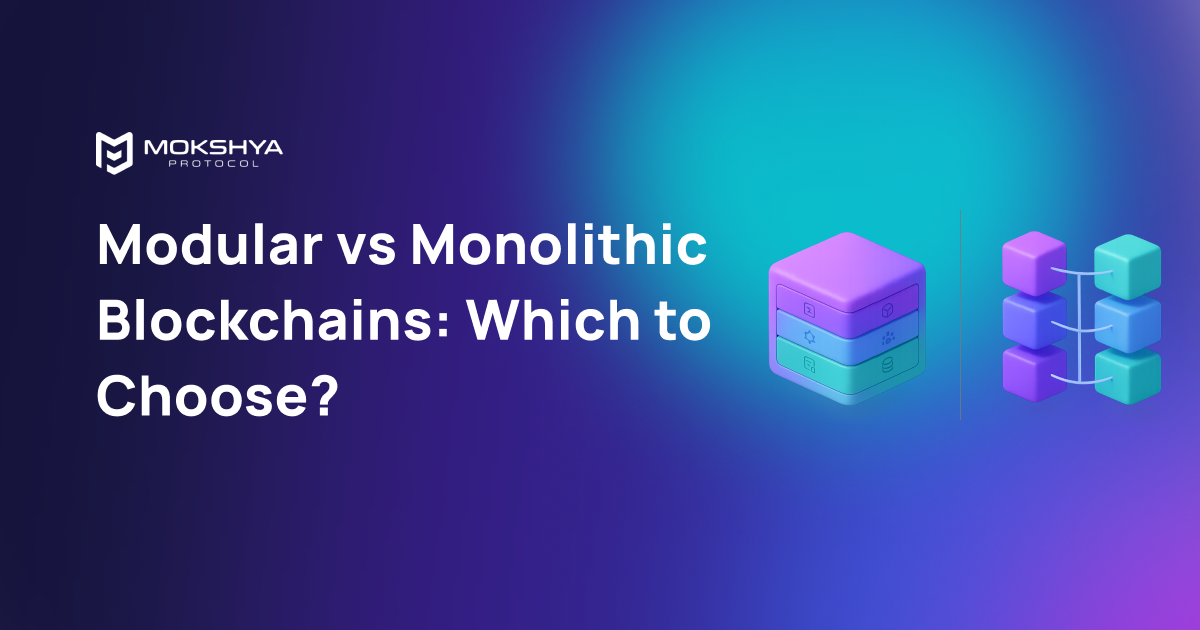
Blockchain technology continues to evolve as developers look for better ways to build scalable and efficient applications. One of the most important discussions today is about modular vs. monolithic blockchains. These two approaches define how blockchain systems are designed and how they perform under real-world conditions.
If you are building decentralized applications (dApps), understanding this difference is essential. It helps you choose the right architecture for performance, cost, and long-term growth.
What Are Blockchains?
Blockchain technology is a distributed system that records transactions across multiple nodes instead of relying on a central authority. This design improves transparency, security, and data integrity. Once information is recorded, it cannot be easily changed, which ensures trust among users. Because of these features, blockchain technology plays a key role in building secure and reliable decentralized applications.
Every blockchain performs four core functions: execution, consensus, data availability, and settlement. Execution processes transactions and smart contracts, while consensus ensures all nodes agree on the network’s state. Data availability stores transaction information, and settlement finalizes transactions. The way blockchain technology organizes these functions defines its overall architecture, which leads to the difference between modular and monolithic designs.
What Is a Monolithic Blockchain?
A monolithic blockchain is a system where all core functions: execution, consensus, data storage, and settlement—operate within a single layer. This unified design keeps everything tightly integrated, making the system easier to build, manage, and maintain. Because all components work together as one unit, monolithic blockchains offer simplicity and straightforward architecture, which is why many early blockchain networks adopted this approach.
What Is a Modular Blockchain?
A modular blockchain is a system that separates core functions such as execution, consensus, data availability, and settlement into different layers instead of handling everything in a single structure. Each layer performs a specific role, which allows developers to optimize and scale individual components without affecting the entire system. This design improves flexibility and scalability, making modular blockchain architecture suitable for modern Web3 applications that require high performance and customization.
Modular vs. Monolithic Blockchains: Key Differences
Monolithic blockchains use a single-layer architecture where all core functions are integrated, which limits scalability but keeps the system simple. Modular blockchains separate functions into multiple layers, which improves scalability and flexibility but adds complexity.
| S.N | Monolithic Blockchains | Modular Blockchains |
| Monolithic blockchains use a single-layer architecture where all core functions operate together. | Modular blockchains use a multi-layer architecture where each function operates independently. | |
| Monolithic blockchains handle execution, consensus, and data availability within one unified system. | Modular blockchains separate execution, consensus, and data availability into different layers. | |
| Monolithic blockchains have limited scalability because all processes run on the same layer. | Modular blockchains achieve high scalability by allowing each layer to scale independently. | |
| Monolithic blockchains offer limited flexibility for customization and upgrades. | Modular blockchains provide high flexibility and allow developers to customize specific layers. | |
| Monolithic blockchains are easier to design, deploy, and maintain due to their simple structure. | Modular blockchains are more complex to design and require coordination across multiple layers. | |
| Monolithic blockchains rely on a unified security model within a single system. | Modular blockchains depend on security mechanisms across multiple layers, which require careful integration. | |
| Monolithic blockchains are best suited for simple or small-scale applications. | Modular blockchains are better suited for large-scale and complex applications. | |
| Monolithic blockchains make it difficult to upgrade individual components without affecting the whole system. | Modular blockchains allow developers to upgrade or replace individual layers without impacting the entire system. | |
| Monolithic blockchains may experience network congestion and higher transaction fees during peak usage. | Modular blockchains improve performance and reduce congestion by distributing workloads across layers. |
Why Modular Blockchains Are Gaining Popularity?
Modular blockchains are gaining popularity because they address one of the biggest challenges in blockchain technology: scalability. By separating core functions like execution, consensus, data availability, and settlement into different layers, these blockchains can handle more transactions without slowing down. This makes them ideal for high-traffic applications such as DeFi platforms, NFT marketplaces, and large-scale Web3 projects. Developers can also optimize or upgrade individual layers without disrupting the entire system, which adds flexibility and efficiency.
Another reason for their growing popularity is the rise of multi-chain ecosystems and cross-chain applications. Modern blockchain projects often need to interact with multiple networks, and modular architecture makes this much easier. Innovations like rollups rely on modular designs to improve performance and reduce fees. Additionally, modular blockchains are increasingly being explored alongside AI and blockchain technologies, enabling smarter, automated, and data-driven decentralized applications. As the demand for scalable, interoperable, and efficient blockchain solutions grows, modular blockchains are becoming the preferred choice for developers building the next generation of decentralized applications.
How Mokshya Protocol Supports Modular Development?
Mokshya Protocol provides tools that simplify blockchain development across both modular and monolithic environments.
Smart Contract Libraries and Templates
Mokshya Protocol offers prebuilt smart contract templates for tasks such as staking, NFT minting, and token management. These ready-made contracts save developers time, reduce errors, and ensure consistent performance, allowing teams to focus on building unique features instead of writing code from scratch.
Web3 SDKs and Developer Tools
The platform provides comprehensive SDKs and developer tools that simplify integration and automate repetitive coding tasks. This helps developers streamline dApp development, connect different blockchain components efficiently, and reduce the complexity of building on modular or monolithic blockchains.
Cross-Chain Development Support
Mokshya enables developers to build applications that operate across multiple blockchain networks. This cross-chain capability aligns with modular blockchain design, allowing apps to interact with various chains while maintaining performance, security, and scalability.
Open-Source Infrastructure
All Mokshya tools and frameworks are fully open-source, promoting transparency and community collaboration. Developers can modify and extend these resources to fit their project needs, making it easier to innovate and adapt to evolving blockchain requirements.
Documentation and Tutorials
Mokshya provides clear, step-by-step guides and examples to help developers learn blockchain concepts quickly. These resources reduce the learning curve, explain complex processes in simple terms, and ensure teams can implement solutions efficiently and effectively.
Which Blockchain Architecture Should You Choose?
Choosing the right blockchain architecture depends on your project’s needs. Monolithic blockchains are best for simple, small, or early-stage projects where fast deployment is important, as they integrate all functions in a single layer. Modular blockchains are ideal for projects that expect high user growth, require scalability and flexibility, or need to interact with multiple networks, since they separate functions into layers for better performance. Overall, modular design provides long-term advantages for complex applications, while monolithic systems remain effective for simpler use cases.
Bullet Version:
- Monolithic Blockchain: Simple, small, or early-stage projects; fast deployment; single-layer integrated system
- Modular Blockchain: High user growth, scalable and flexible applications; multi-layer design for better performance; supports cross-chain interactions
- Insight: Modular architecture is better for long-term, complex projects, while monolithic is suitable for simpler use cases
Conclusion
Choosing the right blockchain architecture is a critical decision for developers building decentralized applications. Monolithic blockchains offer simplicity, strong security, and ease of deployment, making them ideal for smaller projects or early-stage applications. They are straightforward to manage but face limitations in scalability and flexibility, which can become bottlenecks as usage grows.
On the other hand, modular blockchains provide a flexible, scalable, and performance-oriented approach. Mokshya Protocol supports modular development by offering smart contract templates, SDKs, cross-chain tools, and open-source infrastructure, helping developers optimize individual layers, handle higher transaction volumes, and build interoperable applications. This makes modular systems the preferred choice for modern, complex Web3 projects that require efficiency, customization, and long-term growth. Ultimately, understanding the difference between modular vs. monolithic blockchains helps teams select the architecture that aligns with their project goals, ensuring faster development, better scalability, and a future-ready blockchain solution.